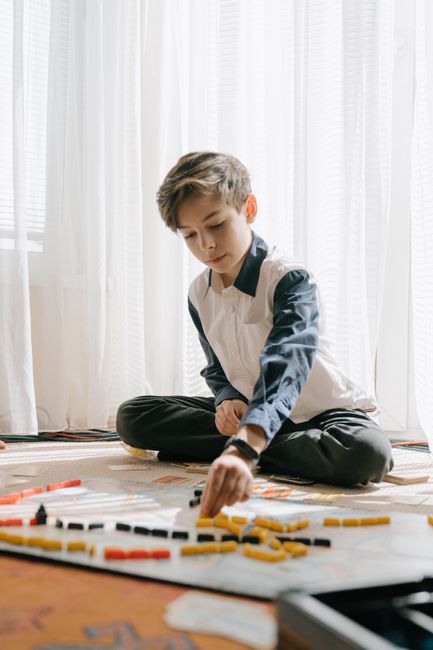
Kids retain what they practice in context they care about, not what they memorize under pressure. When learning lives inside the game world itself, when solving an addition problem genuinely powers your character or unlocks a new corner of the island, the math doesn't fade weeks later. It was never isolated "practice" in the first place. It was part of something real enough to matter.
Marco sat on the edge of the bed watching his eight-year-old daughter Elena at her tablet on a Tuesday evening. Two weeks earlier, she'd abandoned another learning app after the streak counter reset once. He'd watched her face change when the zero appeared at the top of the screen. The app was no longer hers to explore, it was now a debt to repay. This week, Elena was deep in a word garden. On the screen, she was matching syllables to grow plants. Marco noticed her solving a problem she'd struggled with in week one, not because anyone had assigned it to her again, but because the game had woven it back in, this time asking her to use it in a slightly different way.
The Difference Between Remembering and Retaining
Memorization looks fast. Your child drills addition facts for fifteen minutes, gets them all right, and you check it off. Three weeks later, that same child is stuck on 7 + 6. What happened in between? Forgetting. The brain holds on to what it uses, not what it was asked to hold.
A quiz-based model asks the brain to hold something, then tests to see if it stuck. A play-powered model builds retention by making the problem worth solving again and again, in shapes the child didn't predict, so the pattern becomes wired in naturally. Elena didn't keep solving math problems because she finished a section. She kept solving them because the island needed resources, the lighthouse needed fixing, the garden needed tending. The math was the mechanism. The game was the why.
That distinction matters for what stays and what vanishes. Spaced review, the science term for returning to a concept after weeks or months, works best when the child doesn't experience it as review. When Elena solved an addition problem in week three, she didn't think "I'm being spaced-reviewed." She thought "I need to fix this bridge." The math lived alongside her immediate goal. The retrieval felt purposeful, not punitive.
How the Game World Creates Natural Practice Loops
The island keeps evolving. As Elena progressed, the problems got harder, but so did her reasons for caring. Early on, she solved 4 + 3 to unlock a new section. Weeks later, 4 + 3 appeared again, embedded in a more complex puzzle. She'd already solved it dozens of times by then, but not because someone made her practice it. The world kept asking.
By the time a more demanding problem appeared that needed that foundation, she wasn't learning it fresh. She was building on something that felt automatic. This is how mastery actually develops: not through completion of a worksheet, but through repeated small encounters with the same ideas in gradually shifting contexts. The game doesn't wait for her to prove she knows something before moving on. It trusts that she'll strengthen what she needs as she builds.
Why Pressure-Based Learning Breaks the Loop
Marco thought back to the other app Elena had used. It was colorful, it had badges, and it had a streak counter that reset to zero if she missed a day. The math problems themselves were fine. But the moment the streak broke, something shifted in Elena's face. It became work. It became failure. She wasn't thinking about the math anymore. She was thinking about getting back to zero.
With Jambolino, there's no streak to break. There's no timer counting down. There's just the next thing the world needs from you, and if you take a week off, the island is still there. Elena's progress doesn't depend on daily perfection. It depends on what sticks because she used it for real reasons, over weeks and months, in ways that kept surprising her.
When Marco watched her solve that week-one problem again, three weeks deeper into the game, he saw the math land differently. Not as a task to survive. As a tool she already knew, using it again because something had to work, and this time it did.
Comments
No comments yet.