The best use of one last free afternoon is a short learning session that still feels like play. When solving the maths directly changes a world, a child can practise without spending Sunday staring at a worksheet pack.
In 1967, Seymour Papert, Wally Feurzeig and Cynthia Solomon were developing Logo at Bolt Beranek and Newman in Cambridge, Massachusetts. The idea put a serious question on the table: could children learn mathematical thinking by controlling something themselves, rather than receiving another explanation?
Logo let children give instructions to a turtle that moved and drew. Angles became turns. Distance became motion. A mistake appeared in the resulting path, where the child could inspect it, revise the instructions and try again.
Papert later documented this approach in Mindstorms: Children, Computers, and Powerful Ideas. The turtle mattered because mathematical ideas had visible consequences. Children used geometry to make something happen.
That same principle can rescue the last Sunday before school.
The worksheet on the table
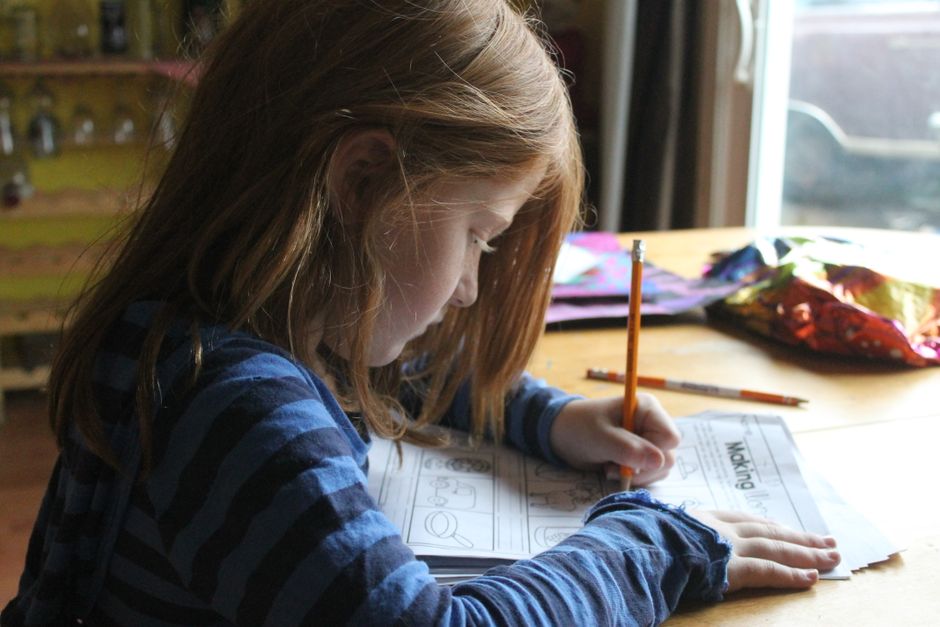
The worksheet pack is untouched. The pencils are still in their case. Outside, there is enough afternoon left for the park, a bike ride or one more slow hour before bags, uniforms and alarms return.
A parent can see the sensible argument for opening the pack. A little practice may make Monday easier. The child can see something else: school arriving early.
That tension rarely needs a grand solution. It needs a better first five minutes.
Instead of announcing a revision session, open Jambolino in the browser and let the child choose a profile. A clockwork island waits in the dusk. Its machinery needs power. The child solves a real mathematics challenge, and the result reaches beyond a correct-answer mark. A structure can grow. A dormant part of the isle can wake.
The arithmetic remains real. Depending on the child’s level, the challenge might involve counting, number sense, multiplication, fractions, percentages, geometry or introductory algebra. The difference lies in what the answer does.
The worksheet asks for completion. The island gives the child a reason to use the maths.
Let the consequence carry the lesson
Papert’s turtle made an abstract instruction visible. If the program was wrong, the path showed it. Revising the command changed the drawing.
Jambolino follows the same learning principle in a different setting. Solving powers the machinery and restores the child’s persistent world. The learning action drives the play directly.
That distinction matters during a fragile transition such as the final afternoon before school. A child who rejects “revision” may still want to repair a machine, balance quantities or earn what a structure needs. The invitation can stay concrete: “Want to wake one part of your island?”
There is no need to disguise the subject. Children can see the numbers, make choices and discover what their answers change. This is the practical lesson inside the Logo story: motivation grows when knowledge becomes a tool the child can operate.
For another example of a small challenge producing a visible change, read The Five-Minute Challenge That Changes a Child’s World.
Keep Sunday small
The goal is a warm return to mathematical thinking, not a heroic catch-up session.
Let the child choose the world or challenge where possible. Jambolino adapts from the child’s mastery state and can gently step down after repeated struggle. Skip-ahead checks also let a child move past material they already know. That helps keep the work near productive difficulty without turning the afternoon into an assessment.
Then watch for a natural stopping point. One powered machine or completed structure can be enough. Jambolino has no streak loss, countdown pressure, advertisements, in-app purchases or loot boxes pushing the child onward. The persistent world will still be there tomorrow.
Parents can review actual skill progress later through the parent experience and weekly digest. Sunday itself can remain simple: one child, one challenge, one visible consequence.
If you are weighing the value of this kind of session against another digital worksheet, this guide to educational screen time and intrinsic learning games explains the difference in more detail.
Leave room for the final afternoon
Papert’s turtle did not make mathematics smaller. It gave mathematical thinking somewhere to go.
That is the standard worth applying on the Sunday before school. The child should finish with evidence that their thinking changed something, not with the sense that leisure was confiscated for an early start on Monday.
Put the worksheet pack aside for five minutes. Open the browser. Let the child solve one real problem and watch a clockwork structure respond. If they stop after that, the afternoon still belongs to them, and the maths has already begun to wake.
Comments
No comments yet.