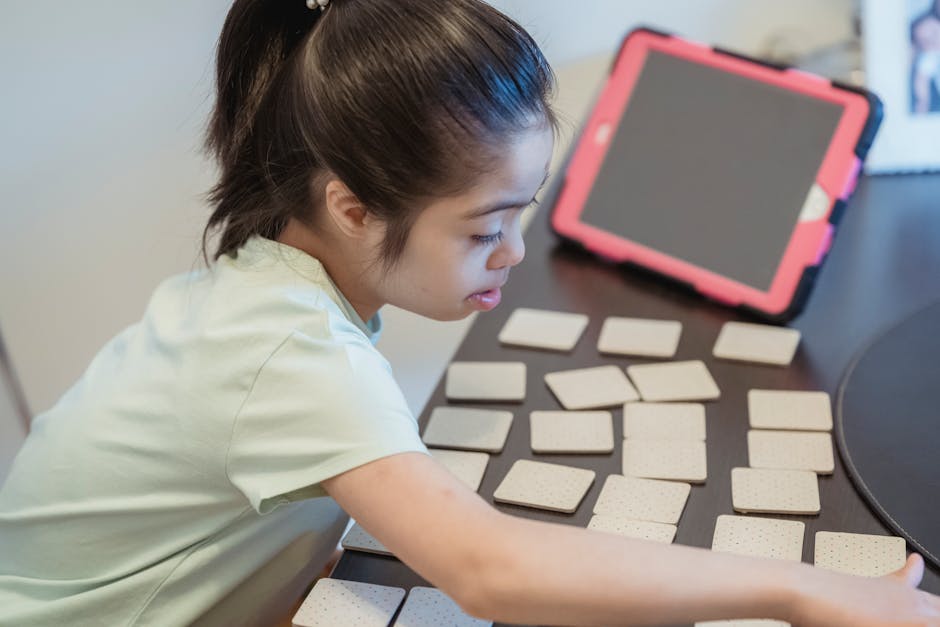
A fraction challenge becomes meaningful when a child’s reasoning causes a visible, lasting change in the game world. In Jambolino, solving the fraction powers progress on the child’s island, so the mathematical step and the reward belong to the same moment.
At 6:17 on a rainy Thursday, nine-year-old Mila is holding her parent’s tablet at the kitchen table. Her toast has gone cold. On screen, a brass island machine needs five eighths of a power charge, and the pieces available show three eighths and two eighths.
Mila has already tried six eighths twice. If she misses again, the machine stays quiet, the structure remains unfinished, and the few minutes available before dinner may end with the island exactly as she found it.
This scene is an invented composite, but the challenge and response reflect how Jambolino works.
The reasoning happens inside the island
Mila touches the first fraction piece: 3/8. Then she chooses 2/8.
She pauses over the answer. Three plus two makes five, but she previously added the denominator as well. That produced 5/16, and the machine rejected the charge.
This time, the picture gives her something concrete to inspect. Both pieces divide a whole into eighths. The pieces are the same size, so she counts how many eighth-sized parts she has altogether.
Three eighths. Two more eighths. Five eighths.
The denominator stays eight because the size of each part has not changed. Only the number of those parts has changed.
That is the unlock.
The server grades the answer deterministically. There is no vague judgment and no answer stored on the child’s device. When Mila submits 5/8, the machine responds to the mathematics she has completed.
One correct fraction changes something she can see
The charge reaches the island apparatus. Its dormant mechanism begins moving, amber light returns to the structure, and the restored location remains part of Mila’s persistent world.
The important connection is short enough for a child to follow:
I combined the fractions. That created the right charge. The charge powered this machine. My island changed.
A detached reward would weaken that chain. A random prize could celebrate any tap, guess, or repeated action. Here, the fraction itself creates the progress. Mila needed to understand what the eighths represented before the island could move forward.
That principle shapes Jambolino’s wider approach. Children count, spell, route trains, predict experiments, identify places, and work with musical patterns through playable subject worlds. Solving real learning challenges earns world-specific currency for building and upgrading structures. Completed buildings remain places children can enter and explore.
The learning action carries the story forward.
Productive difficulty keeps the moment within reach
Mila’s two wrong attempts matter. The game does not scold her, erase a streak, or threaten a countdown. It gently lowers the difficulty after repeated struggle and schedules useful material for review.
The target is productive difficulty: demanding enough to require thought, yet reachable without turning a short session into a battle. Children who already understand a skill can use skip-ahead checks or optional placement instead of repeating material they have mastered.
For a parent nearby, the best intervention may be one prompt: “What stays the same about the pieces?” That preserves the child’s reasoning without supplying the answer. How Can I Help My Child Get Unstuck Without Taking Over? explores that handoff in more detail.
The parent experience later shows actual skill progress and mastery, rather than measuring how long Mila kept an app open. Weekly email digests offer a quick view without turning the evening into another dashboard session.
The restored machine becomes a memory cue
Dinner is called. Mila sets down the tablet, but before leaving she looks once more at the lit structure.
The next time she returns, the island still carries the result of her work. There is no streak loss waiting for her and no loot box demanding attention. The machine remains restored because she worked out that three eighths plus two eighths equals five eighths.
That visible change gives the fraction somewhere to live in memory. Five eighths has become more than an answer she entered correctly. It is the charge that woke a particular corner of her island.
For parents choosing learning games, that is a useful test: ask what the child must understand to make the interesting thing happen. If learning merely interrupts the play, children quickly notice. When the reasoning operates the world, getting better becomes part of what they came to do.
At 6:24, Mila leaves the table. Behind her, the brass mechanism is still turning, and five eighths is the reason why.
Comments
No comments yet.