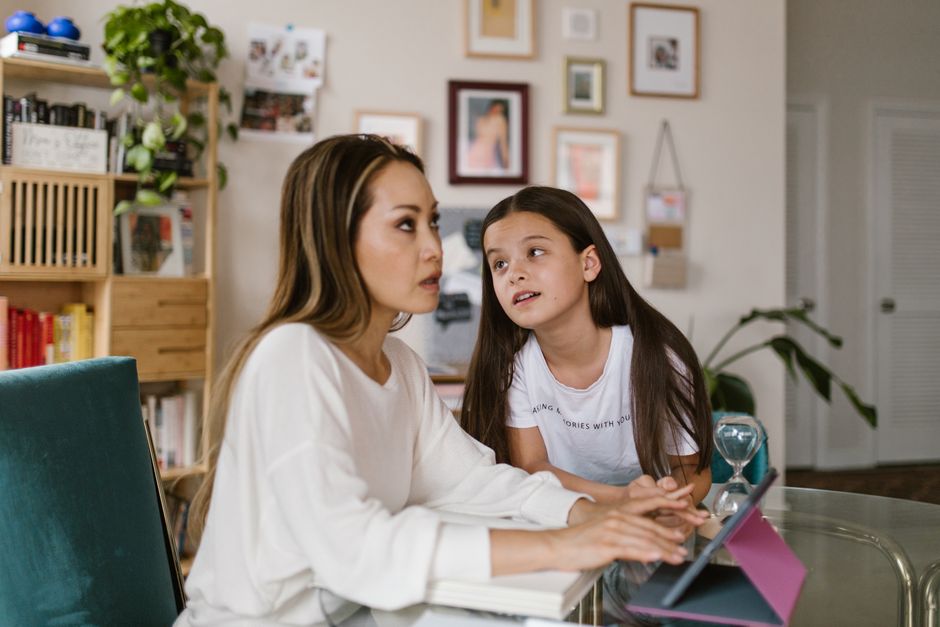
Forty quiet minutes prove very little by themselves. The useful test comes afterward: ask your child, “What did you just do?” A one-sentence answer that names the problem, choice, or idea gives you stronger evidence of learning than silence, points, or screen time alone.
In April 1970, the Apollo 13 crew faced a problem that demanded exactly this kind of evidence. After an oxygen tank exploded, the spacecraft’s carbon dioxide level began to rise. The lunar module had round openings for scrubber cartridges, while the available command module cartridges were square.
NASA engineer Ed Smylie and a team in Houston had to create an adapter using materials already aboard the spacecraft. Then Mission Control had to explain the construction to astronauts Jim Lovell, Jack Swigert, and Fred Haise. The instructions needed to survive a journey from a table in Houston to a damaged spacecraft nearly 200,000 miles from Earth.
The adapter worked. Lovell and Jeffrey Kluger document the episode in Lost Moon, their account of the mission.
The crucial part was not that engineers had spent time on the problem. It was that they could turn their understanding into a clear sequence another person could follow. Their explanation had consequences.
Your child’s answer after a learning session carries far smaller stakes, of course. Yet the mechanism is similar: real understanding leaves something that can be expressed, demonstrated, corrected, or used.
Silence can hide two very different experiences
A quiet child might be concentrating on fraction equivalence. They might also be collecting coins, watching animations, repeating a memorized tap pattern, or waiting for the app to reveal the right answer.
From the kitchen, those experiences can look identical.
That makes “Were you good?” a weak follow-up. So is “Did you have fun?” A child can truthfully say yes without remembering the learning task. Asking for a score has the same problem because a score reports what the system counted, not what the child understood.
Try one concrete prompt instead:
“What did you just do?”
Useful answers can be short:
“I made two fractions have the same bottom number.”
“I listened for the first sound in each word.”
“I changed the train instructions so it reached the station.”
“I tested which object would sink.”
The grammar does not matter. Technical vocabulary does not matter. You are listening for a connection between an action and its purpose.
Look for the learning inside the play
Children should not need to leave the game to prove they learned. The best learning play makes the idea itself memorable because the child used it to change something.
In Jambolino, a child solves real challenges to power and restore a persistent world. Maths can operate machinery. Reading can send letters through Owl Post. Logic can route trains. Science can control an experiment. The visible result gives the child a reason to care, while the learning action remains central.
That distinction matters. A virtual sword earned after twenty unrelated sums may be memorable while the sums disappear. A machine powered by balancing quantities ties the memorable moment to the mathematical idea.
This is also why Jambolino avoids loot boxes, streak-loss pressure, advertisements, and public profiles. Those systems can produce repeated tapping without offering a clear answer to the silence test. The product instead grades answers on the server, adapts challenge difficulty, schedules review, and gently steps down after repeated struggle.
Parents can review skill progress and receive weekly digests, but the child’s own explanation still reveals something a dashboard cannot: what remained in their mind when the screen stopped.
For a related way to separate meaningful play from reward chasing, read The Problem with “Skinner Box” Math Games.
Ask without turning playtime into an exam
The silence test should feel like curiosity, not an inspection.
Ask once. Accept one sentence. Resist correcting every missing detail. If your child says, “I moved the sounds together to make a word,” that is useful evidence even if they do not say “blending.”
A follow-up can make the idea more visible:
“Show me one.”
“What changed when you tried that?”
“Which part was difficult?”
“How did you fix it?”
If they cannot answer, avoid treating that as failure. Ask them to show you the last activity, or return to one example together. Helping a child get unstuck without taking over often starts with watching what they try before supplying an explanation.
Repeated blank answers are still valuable information. Perhaps the rewards dominate the lesson. Perhaps instructions are unclear. Perhaps the level is too easy, so the child taps automatically, or too difficult, so guessing replaces reasoning. Forty peaceful minutes may have helped the household, but quiet and learning remain separate outcomes worth measuring separately.
Run the test tonight
After the next session, wait until the device is down. Then ask the question in a neutral voice.
“What did you just do?”
Write down the answer exactly as your child gives it. Do the same after two or three more sessions. You are looking for concrete verbs such as counted, blended, compared, predicted, built, routed, tested, or corrected.
Back in Houston, Ed Smylie’s team could describe an awkward adapter clearly enough for three astronauts to build it from the materials around them. That clarity showed the work had produced usable understanding.
Your version can be much simpler. After forty quiet minutes, one honest sentence should tell you what the screen time was for.
Comments
No comments yet.