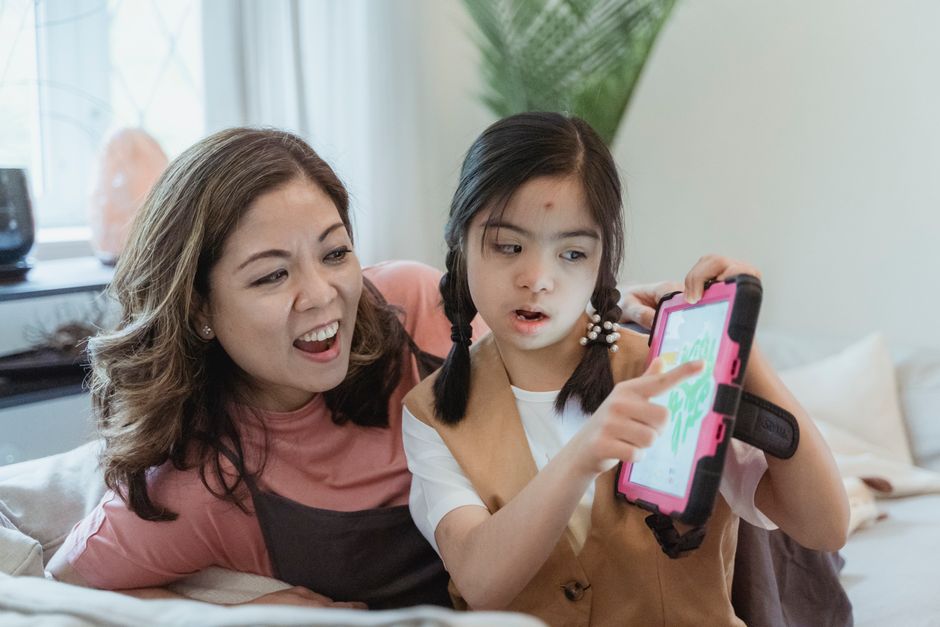
Ten quiet minutes can become worthwhile educational screen time when the child must predict, test, and revise an idea. The strongest learning games give the child something worth thinking about, then make that thinking change what happens on screen.
Imagine Nina at 6:17 p.m. in a flat in Valencia, still wearing one work shoe while she stirs a pan with a wooden spoon. Her eight-year-old son, Mateo, is circling the kitchen asking when dinner will be ready. She hands him the tablet.
The plan is simple: keep him occupied until the pasta is on the table.
A few minutes later, Mateo calls from the sofa. “Will the big one sink?”
Nina nearly answers without looking. Then she sees the challenge: several objects are waiting beside a tank, and Mateo must predict what each one will do before testing it. He has already guessed that the largest object will sink. If he is wrong again, he might close the game and switch to a video before discovering why.
The sauce can wait for one stir.
A prediction gives screen time a purpose
Nina sits on the arm of the sofa. Mateo points to the larger object and explains his rule: big things sink, small things float.
It is a reasonable rule. It is also about to fail.
He makes his prediction and starts the test. The object reaches the water. For a moment, neither of them knows what will happen.
It floats.
Mateo looks at Nina, then back at the screen. The surprise matters because the game asked him to commit first. He had an idea, watched it meet evidence, and now needed a better idea.
That small sequence carries more learning than tapping through facts about buoyancy. Prediction creates a reason to pay attention. Testing makes the result visible. A surprising outcome opens the door to revision.
Nina asks, “So what else could matter besides size?”
Mateo studies the remaining objects. Dinner has ceased to be the only countdown in the room. They both want to see the next test.
The learning should move the world
A weak learning game often separates work from reward. Complete a quiz, then receive coins. Answer a question, then unlock an unrelated animation. Children quickly understand the bargain: endure the school-shaped part to reach the entertaining part.
Jambolino takes a different approach. In its science challenges, children investigate ideas through playable apparatus such as sinking tests, circuits, balances, and life cycles. In its other subject worlds, they route trains to explore first coding, work with sounds and words to develop reading, and use mathematical relationships to power machinery.
The action carrying the lesson also carries the play.
That distinction is easy to miss when choosing an app. Look past the bright characters and ask one concrete question: what does my child have to think about before tapping?
If the answer is “which prize to claim,” the screen is training reward seeking. If the answer is “what will happen when I try this,” the screen can support curiosity, reasoning, and persistence.
The same test applies beyond science. A child arranging instructions so a train reaches its destination must reason about order and consequences. When the route fails, the mistake remains visible in the path. That gives the child something specific to change, much like the coding struggle in Maya’s wrong turn.
Getting stuck should lead somewhere
Mateo tries another prediction. Wrong again.
This is the dangerous moment. Too much difficulty can turn curiosity into embarrassment, especially when a parent is watching. Too little difficulty turns the activity into empty tapping.
A useful adaptive system aims between those extremes. Jambolino grades challenges on the server, tracks mastery by skill, schedules review, and can step the level down gently after repeated struggle. Children can also test ahead when material is already familiar. The goal is productive difficulty: enough uncertainty to require thought, with a reachable next step.
There is no streak to protect and no countdown threatening to erase yesterday’s work. A child can return to the same persistent world without being scolded for missing a day. Progress comes from solving real learning challenges, which earns world-specific currency to build and upgrade structures.
Parents can then review skill progress and weekly summaries. That helps answer the harder question behind educational screen time: did my child master the skill, or merely complete the activity?
Try the two-minute sofa test
You do not need to supervise every tap. Sit beside your child for two minutes and watch for three things.
Can they explain what they are trying to do? Does a mistake give them useful information? Does success come from understanding the learning task?
Back in Nina’s kitchen, Mateo chooses the final object. Before testing it, he changes his explanation. Size alone cannot be the rule, he decides. He wants to inspect what the object is like.
The prediction lands. The test begins.
Nina returns to the stove when he calls after her, still watching the tank: “Wait. I have another idea.”
The tablet bought the ten quiet minutes. It also left a question glowing on the sofa after dinner was ready.
Comments
No comments yet.