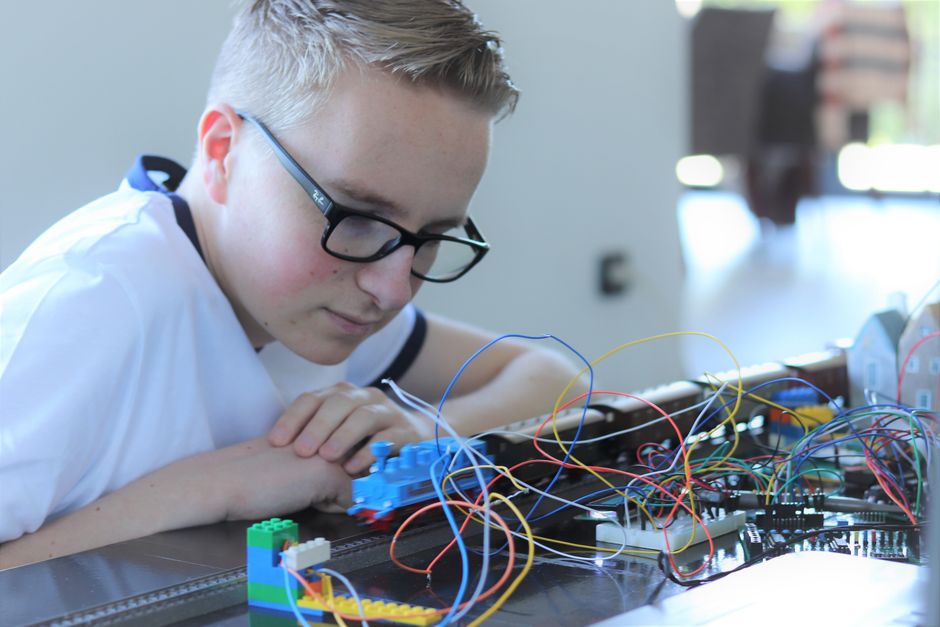
Screen time becomes meaningful when a child repeatedly uses a concrete skill, sees what that skill changes, and a parent can verify progress beyond minutes watched. The useful evidence is in the work: a route repaired, a word decoded, a circuit completed, a rhythm repeated, or a skill that becomes easier over time.
At 7:43, a parent expects the familiar tablet scene: an autoplay queue, a bright thumbnail, a child half watching while the next video loads itself.
Instead, the screen shows an isle with a newly lit structure. The child has been counting treasures to earn the materials, then building part of a place that remains there tomorrow. A different child profile might be in Wordwood, blending sounds into a word, or in Signal Works, arranging instructions so a train reaches its destination. The screen has held their attention, certainly. The more important question is what their attention was asked to do.
The evidence should be visible in the child’s actions
A learning label proves very little on its own. Meaningful screen time gives a child something to figure out.
That can be early number sense, arithmetic, reading, a food chain, rhythm counting, or a route made from repeat instructions. Each activity should require a decision that depends on the skill. If the child can make progress by tapping rapidly, collecting arbitrary prizes, or waiting for a video to finish, the learning has become background decoration.
In Jambolino, the challenge powers the world directly. Solving a math problem earns currency for the child’s isle. Decoding a word develops the reading world. A program runs, stalls, or reaches its destination according to the route the child built. The game has a visible consequence because the learning action caused it.
That gives a parent a better check than “Was the app educational?” Try: “What did you have to work out to make that happen?” A child who can point to the train route, the balanced circuit, or the word they built has shown more than passive exposure.
Apollo 13 had to prove the fix would work
In 1970, the Apollo 13 crew faced rising carbon dioxide after an explosion ended the planned Moon landing. The lunar module had round openings for carbon dioxide canisters. Spare canisters from the command module were square.
At Mission Control in Houston, engineers had to devise a way to make the square canisters work with the round system using materials available aboard the spacecraft. The outcome was uncertain while the crew was still in danger. The improvised adapter became part of the procedure sent to Jim Lovell, Jack Swigert, and Fred Haise, and it worked.
James Lovell and Jeffrey Kluger document the episode in Lost Moon, the book that later became the basis for Apollo 13. The story endures because the test was plain: the crew needed breathable air. An elegant explanation would not have been enough.
A child’s tablet session carries lower stakes, but parents deserve the same clarity about evidence. “They spent time in a learning app” is an explanation. “They practised fraction comparison at the level they could handle, then earned the parts to repair their workshop” is evidence of a mechanism doing its job.
Look for productive difficulty, then look for the return
The right task should demand effort without becoming a wall. A child who misses a few problems may need review or an easier next step. A child who gets every answer instantly may need a skip-ahead check or harder material. The useful range feels like work they can stay with.
That is why adaptive practice matters more than a fixed stream of questions. Jambolino grades answers on the server, targets productive difficulty, schedules review, and can gently step down after repeated struggle. Children can also test out of material rather than repeating what they have already mastered.
The return moment matters too. A persistent world gives children a reason to come back, while the work they do there remains connected to a skill. There are no ads, loot boxes, streak penalties, or in-app purchases competing for that return. The parent experience can show actual skill progress and weekly digests, giving the adult a way to check what changed.
For a fuller set of checks, see a parent’s checklist for choosing a children’s learning game.
A quick tablet check that changes the conversation
Before handing over the tablet, decide what a good session would leave behind. Perhaps it is one newly understood pattern, a sentence read aloud, a train route debugged, or a structure added to a child-owned world.
Afterward, ask the child to show you the cause and effect. What did they try? What happened when it failed? What changed when they solved it?
Apollo 13’s adapter mattered because it changed the air the crew could breathe. A child’s learning game should leave its own small, observable change: a skill practised, a problem solved, and a world they built through that work.
Comments
No comments yet.